Surviving Paradise
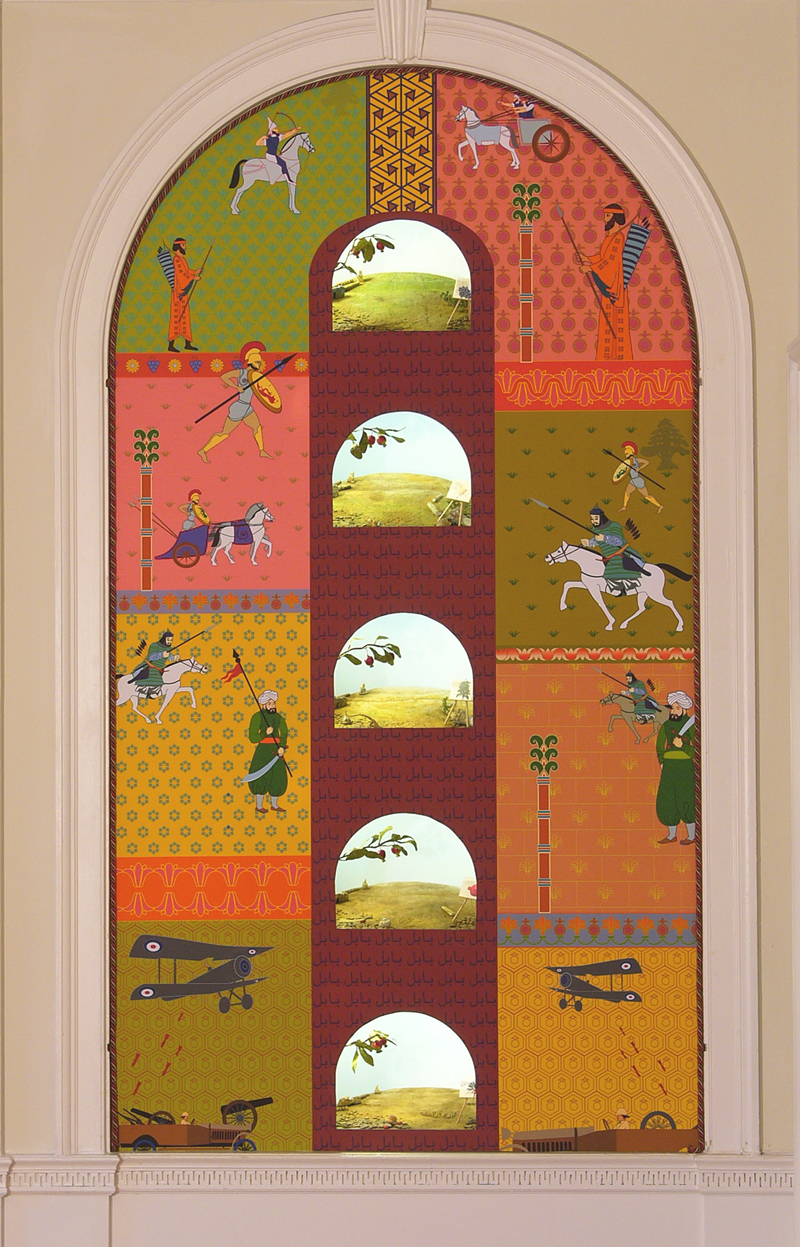
Janet Koenig and Gregory Sholette Mixed media installation: ink-jet print, plaster, powdered pigments, resin, lights 48″ × 84″ × 18″ Glyndor Gallery, Wave Hill, the Bronx, 2006
Mosul, Basrah, Kirkuk, Najaf, Karbala, Fullujah, Baghdad — cities whose names flash across our televisions with news of devastation and suffering — are all located in what was once the cradle of civilization, the Fertile Crescent. A diaspora of plants now central to human diet and industry derive from this once lush region, which also gave rise to agriculture, animal husbandry, and the monotheistic religions.
In Surviving Paradise, Janet Koenig and Greg Sholette create a miniature “epic” theater in which botanical survival and human desire are linked to the repeatedly war-torn landscape of the Middle East. Five dioramas represent the successive impact of human invasions in the region: first by the Persians in 539 BC, followed by the Greeks in 331 BC, the Mongols in 1258 AD, the Ottomans in the 1500s, and finally by the British in 1918, whose discovery of oil radically altered the geopolitics of the region throughout modern times.
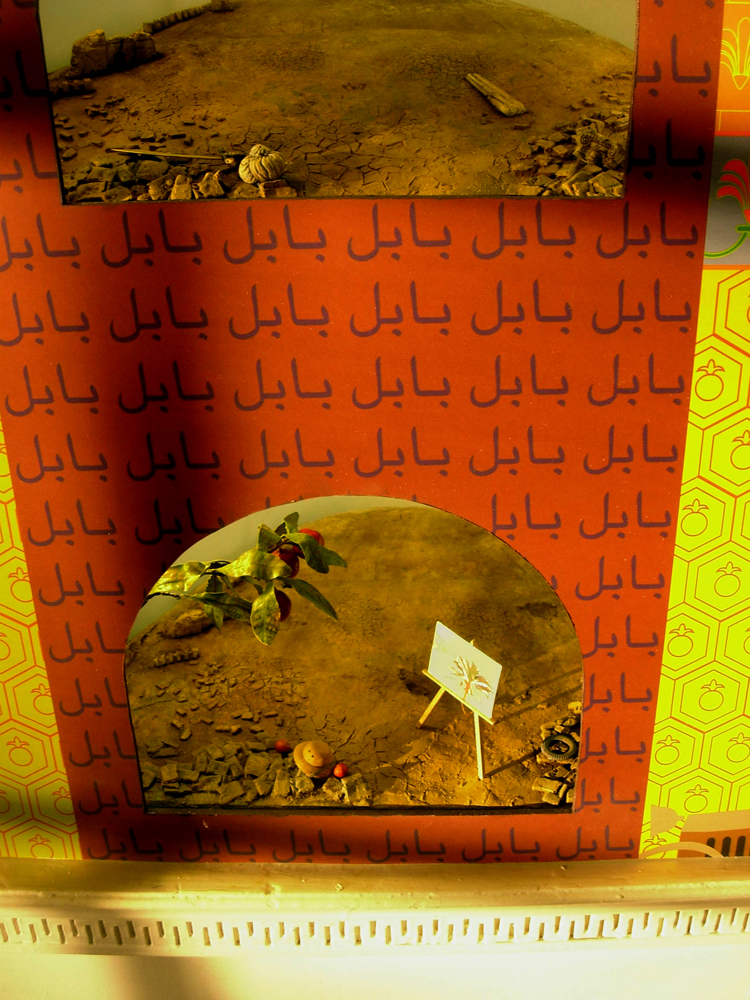
The dioramas chart a process of desertification that intensifies with each conquest, beginning at the uppermost tableau with the impressive irrigation systems that once transformed the arid land between the Nile, Tigris, and Euphrates into a paradise — and descending to the bottom diorama, which reveals a virtual wasteland.
In each scene, a miniature wooden easel implausibly holds a small painting depicting one of five plant species originating from the Middle East — the pomegranate, date palm, cedar, grapes, and lotus flower — all of which are found today at Wave Hill. These miniature stage sets are framed by an archway incorporating ornament inspired by Assyrian and Persian designs, themselves rooted in these same plants, alongside images of the invading Persian, Greek, Mongol, Ottoman, and British warriors. The Arabic word for Babel (Babylon) surrounds the tableaux, alluding to the fantastic and most likely mythical Hanging Gardens.
Surviving Paradise is a study in contrasts where the mythical and the real, the ancient and the modern confront each other at the intersection of botanical survival and geopolitical interest.
(Koenig & Sholette, 2006)